 Hopexchange
 bonders and Conditions for a First V1 Transfer
Updated on
Hopexchange bonders advanced destination liquidity for eligible Hop V1 transfers when an authorized operator had sufficient credit and liquidity. Bonding a first send from a supported rollup or sidechain required an adequate fee and source-chain finality. Ethereum deposits followed native bridge messaging and did not require this individual bonding step. On January 27, 2026, Authereum Labs announced plans to leave primary development and day-to-day stewardship of Hop. The announcement did not specify a shutdown date for deployed contracts. Accelerated V1 delivery depended on working contract access and an active bonder for its selected route.
Route, Asset, and Bonder Credit
A V1 transfer eligible for bonding combined a supported source and destination, the correct asset contract, sufficient sender funds, and an authorized operator with usable credit. The operator needed working access to source-chain events and enough capacity to advance the destination withdrawal. Source-chain finality affected when the operator could act, and the direct V1 SDK send method for canonical ERC-20 tokens also required a spending allowance for the relevant bridge or wrapper. An approval granted that allowance; the send call initiated the transfer. The sender needed source-chain gas for these transactions.
These conditions belonged to the V1 bonding path. Circle's Cross- Chain Transfer Protocol (CCTP) and aggregator branches in the SDK followed separate mechanisms. Selecting USDC could invoke CCTP instead of hToken-based bonding.
Bridge Tokens, Individual Bonds, and Transfer Roots
An hToken represented a bridge asset, while the canonical token was the asset that a normal destination conversion aimed to deliver. V1 used an automated market maker (AMM) for that conversion on supported Layer 2 paths. The operator could supply hTokens through a bonded withdrawal before the corresponding source proof arrived. Returns to Ethereum delivered the underlying asset because Ethereum had no destination Hop AMM. Pool liquidity supported conversion; operator credit supported the advance.
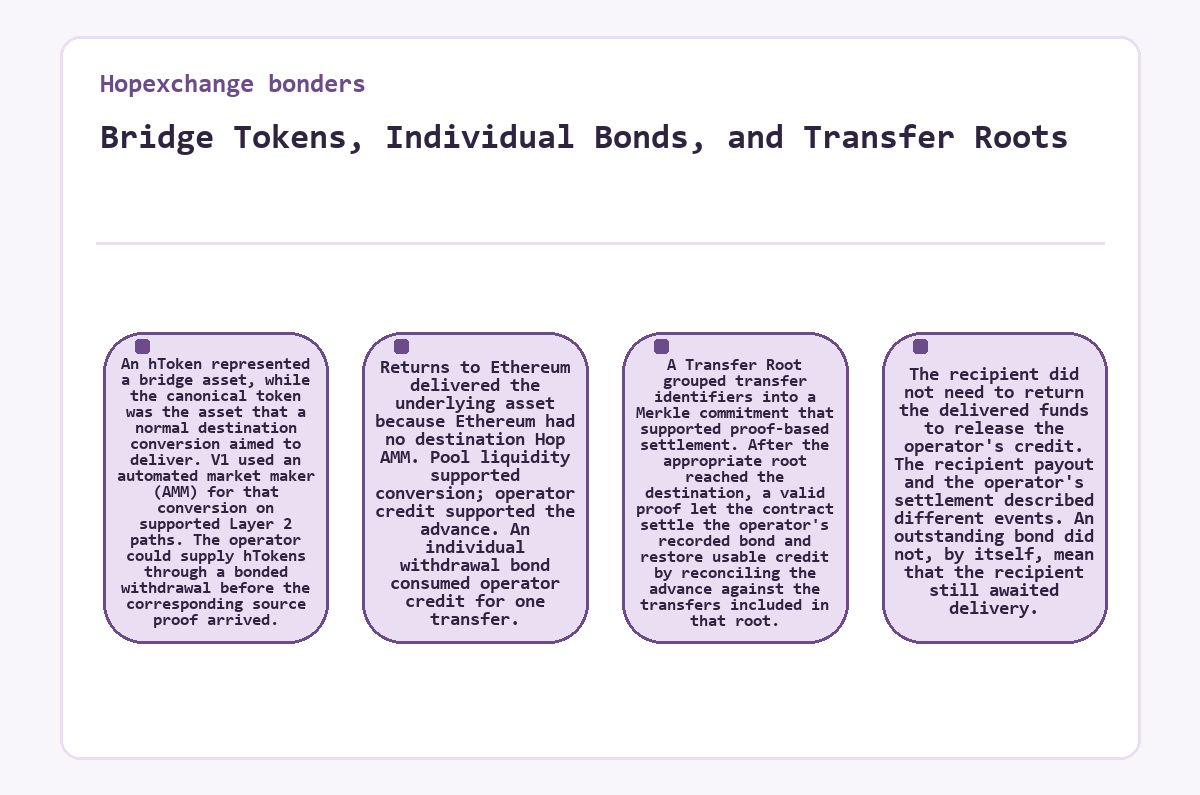
An individual withdrawal bond consumed operator credit for one transfer. A Transfer Root grouped transfer identifiers into a Merkle commitment that supported proof-based settlement. After the appropriate root reached the destination, a valid proof let the contract settle the operator's recorded bond and restore usable credit by reconciling the advance against the transfers included in that root. The recipient did not need to return the delivered funds to release the operator's credit.
The recipient payout and the operator's settlement described different events. An outstanding bond did not, by itself, mean that the recipient still awaited delivery.
What Determined the Cost of a Bonded V1 Transfer?
A bonded V1 transfer's cost reflected operator pricing and destination gas, with source-chain gas and any AMM conversion costs affecting the full expense. The asset and direction determined which components applied, while transfer size affected the relative charge. An absolute floor could dominate smaller sends. The source contract rejected sends whose encoded bonder fee fell below its configured minimum; an operator could require a higher fee. A valid on-chain fee did not compel an operator to supply liquidity.
A V1 bonded withdrawal allocated the committed transfer amount minus its encoded bonder fee to the recipient. The operator received that fee. Any source AMM conversion established the hToken amount recorded for an L2-originating V1 transfer. A destination AMM could then change the canonical-token output. The committed amount therefore did not automatically equal the sender's original token input or final wallet receipt.
Root Collateral and Challenge Windows
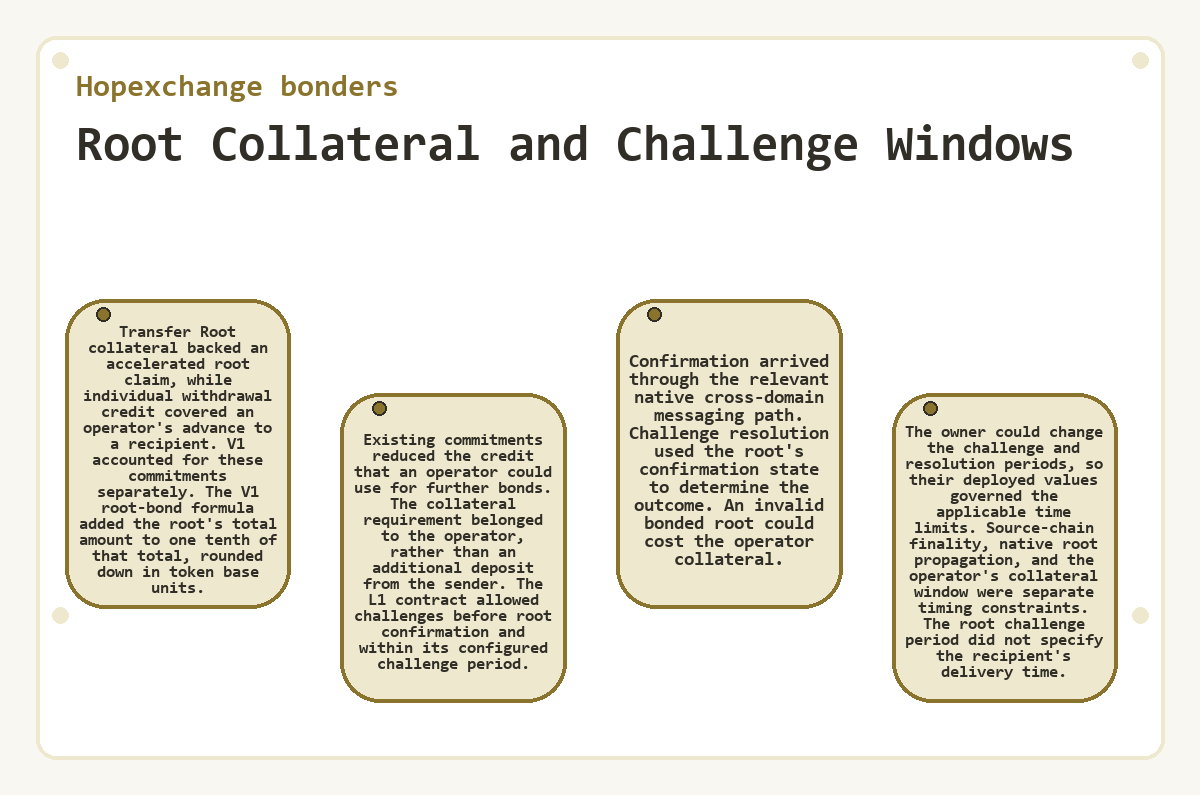
Transfer Root collateral backed an accelerated root claim, while individual withdrawal credit covered an operator's advance to a recipient. V1 accounted for these commitments separately. The V1 root-bond formula added the root's total amount to one tenth of that total, rounded down in token base units. Existing commitments reduced the credit that an operator could use for further bonds. The collateral requirement belonged to the operator, rather than an additional deposit from the sender.
The L1 contract allowed challenges before root confirmation and within its configured challenge period. Confirmation arrived through the relevant native cross-domain messaging path. Challenge resolution used the root's confirmation state to determine the outcome. An invalid bonded root could cost the operator collateral. The owner could change the challenge and resolution periods, so their deployed values governed the applicable time limits.
Source-chain finality, native root propagation, and the operator's collateral window were separate timing constraints. The root challenge period did not specify the recipient's delivery time.
An Insufficient-Liquidity Stop Before Submission
A first send through the direct V1 SDK path could stop at its liquidity check before the SDK submitted a transaction. The expected state was available bonder liquidity at least equal to the required liquidity. An insufficient-liquidity error meant that comparison had failed. An earlier token approval remained a separate on-chain action.
A retry needed usable liquidity to return and a fresh quote for the intended amount. Operator fees and destination gas could change during the wait.
- Keep the intended asset and direction on a supported V1 path.
- Confirm that this attempt has no submitted or pending bridge send.
- Recheck available bonder liquidity against the required amount.
- Refresh the fee quote and confirm sufficient funds for source gas.
If the source receipt confirmed a successful bridge send but no payout had arrived, the sender needed to track delivery or use the applicable withdrawal path. A pending send needed resolution before another submission. A second successful send would create a second transfer, even if the original remained unbonded.
Destination Evidence of a Bonded Payout
A completed V1 bonded payout required a successful destination transaction for the recorded recipient and transfer identifier. The
WithdrawalBonded
event identified the individual bond. Token transfers or native-asset movement showed what the recipient actually received. The source transaction hash alone did not establish destination delivery. Normal bonder delivery did not require the recipient to submit a destination transaction; later token use still required that network's gas asset. A wallet's display also depended on the selected network and token contract.
Unbonded Transfers and the Proof-Based Exit
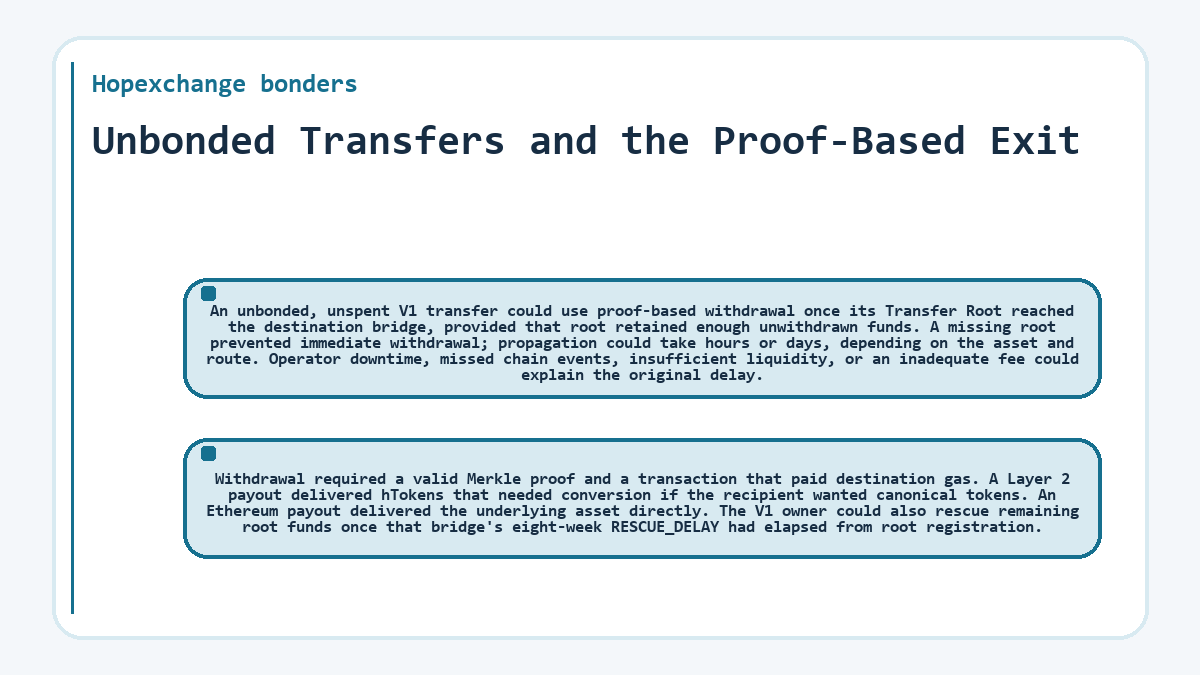
An unbonded, unspent V1 transfer could use proof-based withdrawal once its Transfer Root reached the destination bridge, provided that root retained enough unwithdrawn funds. A missing root prevented immediate withdrawal; propagation could take hours or days, depending on the asset and route. Operator downtime, missed chain events, insufficient liquidity, or an inadequate fee could explain the original delay. Withdrawal required a valid Merkle proof and a transaction that paid destination gas. A Layer 2 payout delivered hTokens that needed conversion if the recipient wanted canonical tokens. An Ethereum payout delivered the underlying asset directly. The V1 owner could also rescue remaining root funds once that bridge's eight-week
RESCUE_DELAY
had elapsed from root registration.
Quick answers
Could Another Authorized Bonder Handle My V1 Transfer?
Another contract-authorized bonder could perform an individual V1 withdrawal even when the source event named a different operator. The named bonder guided source-side grouping, but the contract did not enforce exclusive destination bonding by that address. Availability, adequate credit, and the transfer's encoded fee still mattered. Naming an operator in the send event did not guarantee that an alternative operator would take over.
Did Holding HOP or Providing Pool Liquidity Authorize V1 Bonding?
Holding HOP or depositing pool liquidity did not grant V1 bonder authorization. The bridge restricted bonding calls through its bonder registry. HOP supplied governance voting power, while pool liquidity supported AMM conversions. Operating a node also did not automatically supply contract permission or usable credit. A sender could initiate a transfer without taking on this operator role.
Which V1 Fields Defined the Transfer ID?
The V1 transfer ID hashed the destination chain ID, recipient, amount, transfer nonce, bonder fee, and swap data. The swap data included the token index, minimum output, and deadline. These fields had to agree with the transfer represented by the proof. Replacing a field produced a different identifier. The amount in this identifier included the encoded bonder fee.
Why Did Transfers to Ethereum Need Zero Destination Swap Values?
Ethereum had no destination Hop AMM, so the V1 SDK set destinationAmountOutMin and destinationDeadline to zero for L2-to-L1 sends. Custom destination swap data with nonzero values could prevent the normal bonding path from matching the transfer identifier. This concerned destination swap settings; a source-side AMM conversion had its own minimum-output and deadline values.
Who Received the Bonder Fee During a Manual V1 Withdrawal?
The direct V1 proof-withdrawal call paid no bonder fee to its caller. It distributed the committed transfer amount to the recorded recipient, using zero for the payout fee. The original bonder fee remained part of the transfer ID that the proof had to match. That committed amount could already reflect a source-side conversion, so it did not necessarily equal the sender's original canonical-token input.
Was the Origin Transaction Hash the Same as the Transfer ID?
The origin transaction hash identified the source-chain transaction, while the V1 transfer ID identified a transfer's encoded parameters. The manual-withdrawal interface could accept the origin hash to locate the transfer. That input convenience did not make the two identifiers equivalent. A bridge integration had to distinguish a transaction receipt from the transfer identifier used in Merkle proofs and spent-status checks.
Could a Relayer Redirect the Manual Withdrawal to Another Wallet?
A relayer could submit the ordinary V1 proof withdrawal, but the contract paid the recipient encoded in the original transfer. Changing the recipient changed the transfer ID and broke its match with that proof. Permission to submit a withdrawal did not grant permission to choose a different payout address. The caller still had to provide the required proof and cover transaction gas.
Did Bonding Conceal the Recipient or Transfer Amount?
Bonding did not conceal the V1 recipient address or transfer amount. The source TransferSent event exposed these values, together with the bonder fee and other transfer parameters. Destination events also identified bonded withdrawals. These public records allowed a transfer to be followed across the bridge; the operator's advance of liquidity did not provide a privacy layer.