 Hopexchange
 V1 LP tokens represented your share of a specific liquidity pool
Updated on
Hopexchange used liquidity provider (LP) tokens to represent proportional ownership of individual Hop V1 liquidity pools. The ownership fraction equals the LP tokens attributable to your position divided by that same pool's total LP supply. Multiplying that fraction by each recorded reserve gives the corresponding underlying token exposure. The LP count does not need to match the deposit amount or its dollar value. Pool activity changes reserve composition, while minting and burning change the ownership denominator. A single-token withdrawal applies a separate pricing calculation to determine the selected asset output. Synchronized pool data describes the token backing before withdrawal-specific fees, rounding, and conversion effects.
LP Balances and the Ownership Denominator
An LP balance becomes a pool share only when its denominator comes from the same LP token contract. Call the attributable LP balance x and the total LP supply N. The ownership fraction is x/N, provided N is positive. Multiplying by 100 expresses that fraction as a percentage. Both LP quantities must use the same scale, so their units cancel. Minting additional LP tokens increases N. An unchanged x then represents a smaller percentage, while the new deposit also adds pool assets. That lower percentage alone does not establish a loss.
A successful pool withdrawal burns LP tokens, reduces supply, and removes corresponding liquidity. Reserve balances matter whenever the question concerns underlying token quantities.
Canonical Assets, hTokens, and Pool Reserves
V1 automated market makers (AMMs) paired a canonical asset with its corresponding Hop bridge token, or hToken. The pool supported conversion between those assets, and its LP token represented a share of the combined reserves. An hToken balance and an LP token balance described different objects. Holding an hToken meant holding that bridge asset; holding LP tokens meant owning a fraction of a conversion pool.
Bridge transfers generated demand for those conversions. Bonders supplied accelerated transfer liquidity, while the AMM priced conversions between hTokens and canonical assets. A provider's pool-share calculation concerned the AMM reserves and LP supply. Bonder collateral belonged to separate bridge accounting. The pool assets could appear in unequal quantities even when their intended relationship was close to parity.
From LP Units to Underlying Token Exposure
A pool-share calculation connects an attributable LP balance with the reserves backing that same LP token. Reading the inputs at one block keeps the arithmetic tied to one pool state.
| LP Share Calculation | Required Position and Pool Data |
|---|---|
| Identify the V1 pool and its LP token. | Matching pool and LP token contract addresses on the selected chain. |
| Read the position's LP balance x. | LP units attributable to the position, including any separately recorded stake. |
| Read the total LP supply N. | The same LP token contract and the same block as the position balance. |
| Read and normalize each recorded reserve. | The pool's reserve amounts and each underlying token's own decimal scale. |
| Apply x/N to each normalized reserve. | A positive N and inputs from the same pool snapshot. |
| The calculation describes proportional token exposure before withdrawal-specific fees, rounding, and conversion effects. | |
For normalized canonical-token and hToken reserves C and H, the proportional token amounts are (x/N) times C and (x/N) times H. Each amount retains its own asset units. Unequal reserves remain unequal in the proportional exposure. The arithmetic does not convert hTokens into canonical assets or estimate the cost of doing so. A withdrawal quote can therefore differ even when it uses the same LP balance.
Deposit Composition and LP Minting
A V1 deposit minted LP tokens through the pool's pricing calculation, so the deposit amount and LP count had different units. Comparing those bare counts could make a normal deposit appear short. The LP balance needed its corresponding supply and reserve backing to acquire an economic meaning.
The stableswap calculation measured the change in the pool's invariant, which summarized its normalized balances. In an established pool, the contract scaled that change against the existing LP supply. Deposit composition and applicable fees affected the minted amount.
An established pool accepted one-sided deposits as well as deposits containing both assets. That choice changed the input composition, not the identity of the LP token received. The shared LP token still represented the pooled reserves after the deposit.
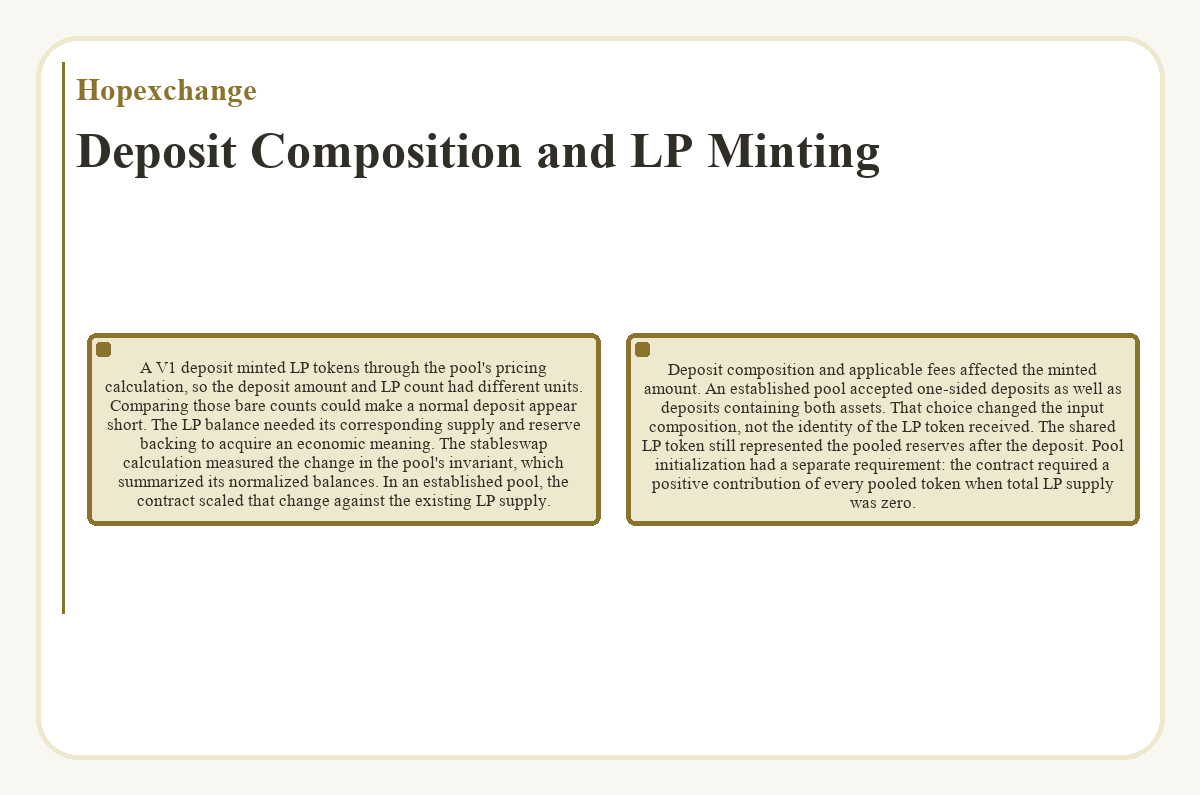
Pool initialization had a separate requirement: the contract required a positive contribution of every pooled token when total LP supply was zero.
Swap Fees and Changing Pool Backing
Swap fees contributed to V1 pool backing when the pool retained them for liquidity providers. A fee-earning swap did not need to mint additional LP tokens to increase the assets supporting existing tokens. Trading also changed the balance between canonical assets and hTokens. Recorded reserves per LP token captured those effects even when the wallet's LP count stayed constant. Pool accounting also distinguished provider reserves from any separately accrued admin fees. Reading only the tokens sitting at the pool's address could include balances that the pool did not treat as LP reserves. Its recorded token balances supplied the appropriate reserve inputs.
Does an LP Share Equal a Single-Token Withdrawal Quote?
An LP ownership fraction does not determine the exact output of a single-token withdrawal. A proportional withdrawal draws amounts from both recorded reserves, subject to any applicable withdrawal fee. A single-token withdrawal uses the stableswap calculation to express the position in one selected pool asset. Applicable fees and pool conditions affect that output.
The V1 SDK exposed separate removal methods for proportional, single-token, and imbalanced withdrawals. Their safeguards reflected those differences: proportional removal carried minima for each asset, while single-token removal carried one minimum output. Imbalanced removal limited the LP tokens that the operation could burn. A quote described an estimate at its calculation state. The transaction reverted if an output fell below its minimum, the required burn exceeded its cap, or execution missed the deadline.
Reserve Exposure and Dollar Valuation
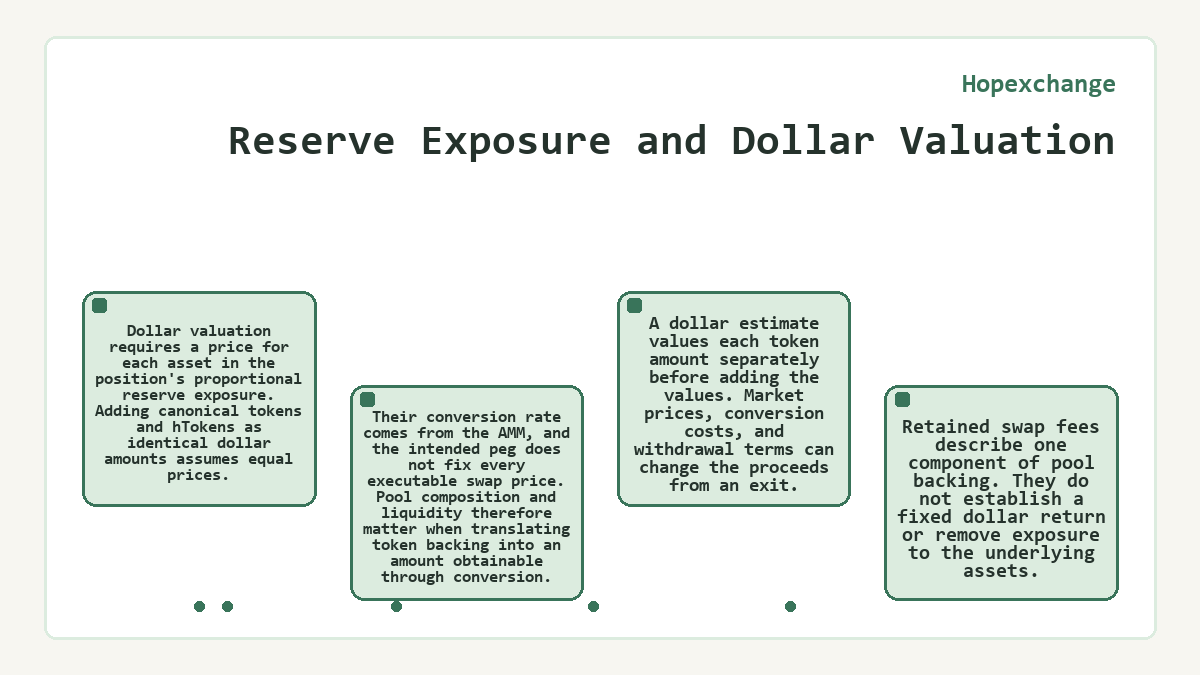
Dollar valuation requires a price for each asset in the position's proportional reserve exposure. Adding canonical tokens and hTokens as identical dollar amounts assumes equal prices. Their conversion rate comes from the AMM, and the intended peg does not fix every executable swap price. Pool composition and liquidity therefore matter when translating token backing into an amount obtainable through conversion.
A dollar estimate values each token amount separately before adding the values. Market prices, conversion costs, and withdrawal terms can change the proceeds from an exit. Retained swap fees describe one component of pool backing. They do not establish a fixed dollar return or remove exposure to the underlying assets.
V1 Positions After the Development Transition
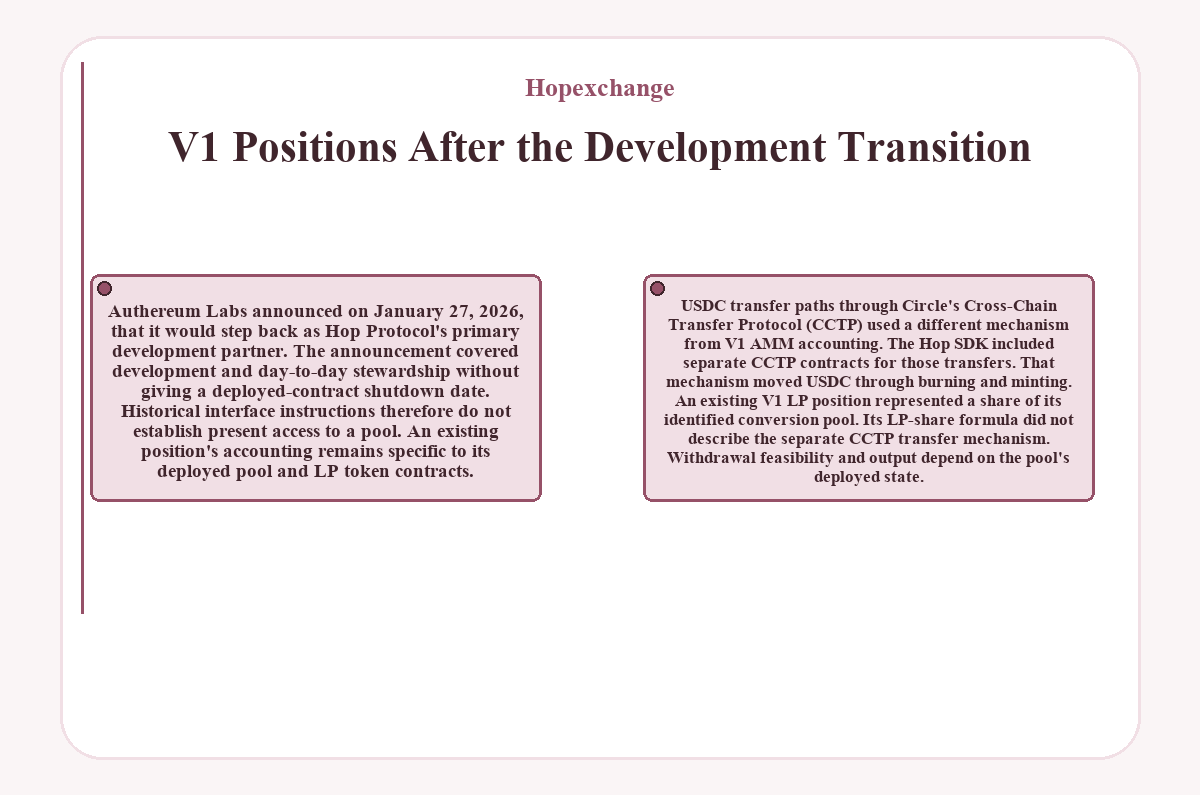
Authereum Labs announced on January 27, 2026, that it would step back as Hop Protocol's primary development partner. The announcement covered development and day-to-day stewardship without giving a deployed-contract shutdown date. Historical interface instructions therefore do not establish present access to a pool. An existing position's accounting remains specific to its deployed pool and LP token contracts.
USDC transfer paths through Circle's Cross- Chain Transfer Protocol (CCTP) used a different mechanism from V1 AMM accounting. The Hop SDK included separate CCTP contracts for those transfers. That mechanism moved USDC through burning and minting. An existing V1 LP position represented a share of its identified conversion pool. Its LP-share formula did not describe the separate CCTP transfer mechanism. Withdrawal feasibility and output depend on the pool's deployed state.
Hopexchange - your questions answered
Why Can a Staked V1 Position Be Missing From My wallet's LP Balance?
Staked LP tokens sit in a staking contract, so a wallet-only LP balance can omit that position. The relevant staking record attributes LP units to the depositor. Those units still refer to the original pool's LP token. Adding attributable wallet and staked units avoids overlooking part of the position without counting the staking contract's entire balance as your own.
Do Unclaimed HOP Rewards Increase My V1 Pool Share?
Unclaimed HOP mining rewards do not add LP units to the pool-share numerator. Where a staking position has accrued separate rewards, its reward balance and LP stake describe different assets. Earning HOP alone does not mint additional LP tokens or increase ownership of the underlying V1 pool.
Which Decimal Scale Applies to Hop V1 LP Tokens?
The Hop V1 Saddle pool implementation uses 18 decimals for its LP token. Raw LP balances and total supply therefore share that scale, which cancels in their ratio. Each underlying reserve keeps its own token's decimals. Applying the LP token's decimal scale to every reserve can materially misstate the resulting asset quantities.
Does Approving LP Tokens Change My Pool Share?
An LP token approval changes the spender's allowance without changing the LP balance or total supply. The approval alone therefore leaves the ownership fraction unchanged. A subsequent withdrawal can burn LP tokens and alter the position. Allowance and ownership are separate contract records, even when an interface presents approval immediately before liquidity removal.
What Does minToMint Protect During a V1 Deposit?
The minToMint parameter sets the minimum LP amount that the deposit must mint. The V1 pool contract rejects a deposit that produces less than this bound. The parameter concerns LP units, so it is different from a minimum amount of an underlying asset. It also does not fix the future dollar value of the minted tokens.
Can V1 LP Tokens Supply HOP Governance Votes?
V1 LP tokens do not supply voting power through the HOP governance token. They represent liquidity-pool shares, while HOP delegation concerns HOP holdings under the governance contracts. A position that also accrued HOP mining rewards held separate assets for separate purposes. Owning the LP position alone did not establish delegated HOP voting power.
Will Withdrawing Part of My LP Balance Close the Entire Position?
A successful proportional withdrawal burns the LP amount specified for that withdrawal, leaving any remaining LP tokens outstanding. The pool removes the corresponding liquidity and reduces total LP supply by the burned amount. The remaining position therefore uses its remaining LP balance and the updated supply. Its percentage must account for both changes.
Is a Pool Share Enough to Calculate My Profit or Loss?
A pool share alone does not establish profit or loss because it omits the position's cost basis. The calculation also needs the value of the remaining assets or actual withdrawal proceeds, together with relevant costs and separately accrued rewards. Comparing LP token counts across entry and exit cannot substitute for valuing those amounts in consistent units.